Stitched Into History: The Engineering Genius Behind Neil Pryde's Sail Revolution
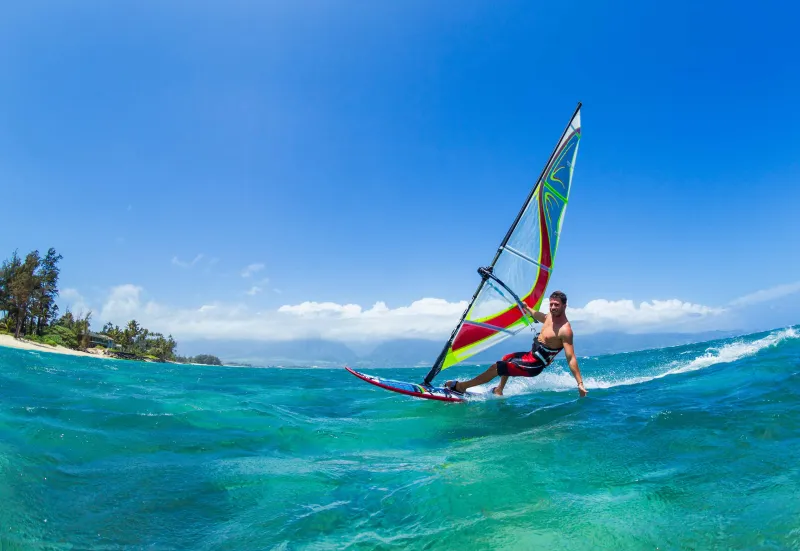
Photo: windsurfing sail close up batten detail engineering ocean Maui, via cdn.checkyeti.com
There's a moment every windsurfer knows — that split second when the wind catches the sail just right, the board lifts, and the whole world goes quiet except for the hiss of water beneath your feet. It feels effortless. But behind that effortless feeling is decades of engineering obsession, and a huge chunk of the credit belongs to one name: Neil Pryde.
Pryde didn't walk into a boardroom and announce he was going to reinvent windsurfing. He started the way most great innovators do — messing around, asking annoying questions, and refusing to accept "that's just how it's done" as an answer.
From Honolulu Back Alleys to the Drawing Board
In the early days of windsurfing — we're talking the late 1970s and into the '80s — equipment was, by modern standards, pretty rough. Sails were heavy, stiff in all the wrong places, and about as forgiving as a brick wall when the wind picked up. Most manufacturers were adapting sailboat technology and hoping it translated to a single rider standing on a board. It mostly didn't.
Pryde, who had already built a reputation as a sailmaker in Hong Kong before falling hard for the windsurfing scene in Hawaii, saw the gap between what riders needed and what they were getting. He wasn't just a businessman looking at market share — he was a sailor who genuinely cared about performance. That combination turned out to be pretty powerful.
His early experiments were low-tech by today's standards. We're talking hand-stitched prototypes, salvaged materials, and a whole lot of trial and error in the water. Maui's legendary conditions — the consistent trade winds, the powerful chop at Ho'okipa, the unpredictable gusts that separate good riders from great ones — served as his testing ground. If a sail could hold up here, it could hold up anywhere.
The Batten Breakthrough That Changed Everything
One of Pryde's most significant contributions to modern windsurfing was his work on full-length batten systems. Before this innovation became standard, sails used shorter battens that only partially stiffened the sail. The result was a lot of flutter, unpredictable power delivery, and a sail that constantly fought the rider rather than working with them.
Pryde's team began experimenting with battens that ran the full width of the sail, combined with carefully engineered tension systems that allowed the sail shape to be tuned precisely. The difference on the water was immediate and dramatic. Sails became more stable, power delivery became smoother, and riders could push harder without worrying about their equipment suddenly collapsing or inverting in a gust.
"When you ride with a well-tuned batten system, the sail almost feels alive in a good way," says Marcus Teller, a professional wave rider based in Maui who has been competing on the PWA circuit for over a decade. "It responds to what you're doing instead of fighting you. That lineage goes straight back to what Pryde was working on in those early years."
Teller, like many pros, grew up hearing about Pryde's innovations secondhand — they were already baked into the equipment by the time he started riding competitively. That's actually the best compliment an engineering breakthrough can receive: it becomes so fundamental that people forget it was ever invented.
Shaping the Wind: Camber Inducers and Profile Control
Another area where Pryde's influence left a lasting mark is sail profile shaping — specifically the development and refinement of camber inducers. These small but critical components sit where the batten meets the mast and help the sail maintain a consistent aerodynamic profile even as wind conditions change.
Before camber inducers became refined, race sails in particular struggled to hold their shape under pressure. As the wind built, the sail would distort, efficiency would drop, and riders would lose speed at exactly the moment they wanted to be going fastest. Pryde's engineering team worked obsessively on the geometry of these components, tweaking angles, materials, and placements across dozens of prototype sails.
The payoff was sails that could hold a near-perfect wing-like profile across a wider range of wind strengths. For competitive sailors, this translated directly into podium finishes. For recreational riders, it meant equipment that was more forgiving and easier to control — a win at every level of the sport.
Jessica Nakamura, a longtime Maui-based instructor who has been teaching windsurfing for over fifteen years, puts it simply: "The gear my students learn on today would have seemed like science fiction in the early '80s. And so much of what made it possible traces back to the kind of obsessive refinement that Pryde brought to the table."
Materials Matter: The Fabric Revolution
It wasn't just the structural elements that Pryde reimagined. His sailmaking background gave him an unusually deep understanding of fabrics, and he pushed hard on material innovation at a time when most manufacturers were still working with whatever was available from the sailing world.
The introduction of monofilm — a clear, rigid plastic film that offered dramatically lower stretch than traditional woven fabrics — was a game changer for sail construction. Pryde's team was among the pioneers in figuring out how to work with monofilm effectively, developing construction techniques that maximized its stiffness and durability while minimizing its tendency to crack and delaminate over time.
Combined with X-ply reinforcement panels and carefully mapped seam placements, these material choices produced sails that were simultaneously lighter, more powerful, and more durable than anything that had come before. The weight reduction alone transformed the feel of riding — sails that don't exhaust you just to hold up let you focus on actually sailing.
A Legacy Still Being Written
What's remarkable about Neil Pryde's engineering legacy isn't just the specific innovations — it's the culture of relentless improvement he embedded in the sport. His approach to design, which combined empirical testing on real water with careful attention to rider feedback, became a template that the entire industry eventually adopted.
Today, the Neil Pryde brand continues to produce equipment that carries those same values forward. Modern NP sails use materials and construction techniques that Pryde himself couldn't have imagined when he was hand-stitching prototypes in Hawaii, but the philosophy underneath them — build for the rider, test in real conditions, never stop refining — is unmistakably his.
For anyone who has ever felt that perfect moment of sail and wind and water clicking into place, there's a good chance Neil Pryde had something to do with making it possible. That's a legacy worth celebrating.