Twenty Miles of Magic: How One Stretch of Maui Coastline Became the World's Greatest Windsurfing Lab
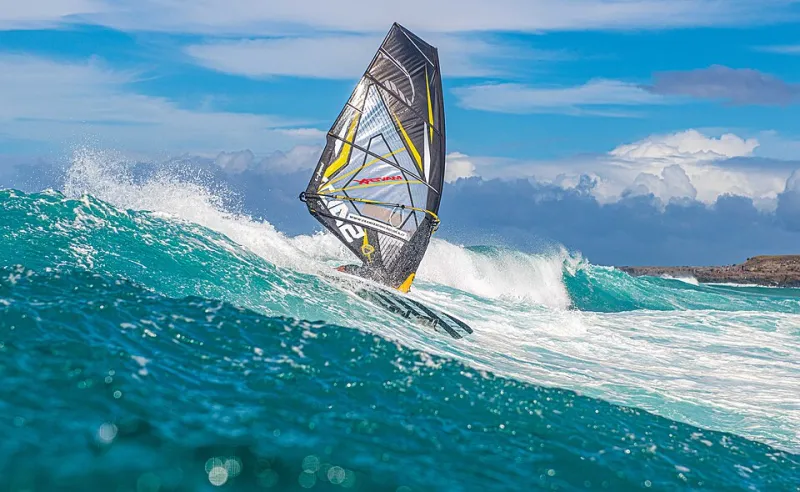
Photo: Scagliolafrancesco353, CC BY-SA 4.0, via Wikimedia Commons
Drive the Hana Highway north out of Kahului and you'll pass sugar cane fields, roadside fruit stands, and the kind of scenery that makes people forget they had somewhere to be. But keep going — past Spreckelsville, through Paia, out toward Hookipa and beyond — and you'll start to notice something else entirely. Kite bags stacked outside rental cars. Boards strapped to every roof rack in sight. A quiet, purposeful energy that feels less like vacation and more like work.
This is the corridor where windsurfing's future gets figured out. And it's been that way for decades.
The Geography Doesn't Mess Around
Maui's North Shore sits at a genuinely rare intersection of natural forces. The island's central valley — that wide, flat expanse between the West Maui Mountains and Haleakala — acts like a giant funnel. Trade winds sweeping in from the northeast get compressed and accelerated as they pass through, arriving at the coastline with a consistency and velocity that's almost engineered.
What you get at spots like Kanaha and Hookipa isn't just wind. It's reliable wind. Wind that shows up on a schedule serious enough to plan a product development cycle around.
"You can test a sail in the morning, make changes over lunch, and be back out on the water by 2 p.m. with a modified prototype," says one equipment designer who has spent the better part of three decades working in the shadow of Haleakala. "Try doing that anywhere else in the world. You'd be waiting days for the right conditions. Here, the conditions come to you."
That kind of rapid iteration is exactly what drives innovation. The 20-mile stretch from Spreckelsville to beyond Hookipa offers designers something genuinely rare: a natural testing environment with enough variety to stress-test equipment across multiple scenarios in a single day.
Wind That Teaches You Things
The trade winds here aren't just strong — they're textured. Sailors and engineers talk about Maui's wind the way musicians talk about a particular instrument. It has character. Gusty pockets near the cliffs. Smoother, sustained pressure out past the reef. Thermal shifts in the afternoon that change everything about how a sail behaves.
For equipment developers, that complexity is a gift. A sail that performs perfectly in steady 25-knot trades might fall apart the moment it hits a gust cycle. A board that feels locked in on flat water inside the bay can become unpredictable when the chop builds offshore. Maui exposes weaknesses fast, and it does it repeatedly, which is exactly the kind of feedback loop that produces better gear.
Neil Pryde's own legacy is deeply tied to this feedback loop. The brand's reputation for precision engineering wasn't built in a factory — it was built on the water, in conditions that demanded honesty from every prototype. If something didn't work here, it didn't work. Period.
The Human Concentration Factor
Geography explains part of the story. But the other part is about people — specifically, the density of elite-level talent that gravitates to this stretch of coastline.
Within a few square miles, you'll find former world champions, current pro tour competitors, self-taught locals who've logged more hours on the water than most professionals ever will, and a rotating cast of designers, engineers, and gear nerds who treat every session as a data collection exercise. That kind of concentrated expertise doesn't exist anywhere else in the sport.
The conversations that happen in the parking lot at Hookipa, or over coffee at a Paia café after a morning session, have shaped windsurfing's direction in ways that never make it into press releases. Riders compare notes. Designers get unfiltered feedback. Someone mentions that the new prototype feels squirrely in the chop, and that observation sets off a two-week redesign process.
"The community here doesn't let you get away with anything," laughs one longtime Maui-based shaper. "You bring out a board that has issues, and you'll know about it by sunset. These guys are brutally honest because they actually care. They want the gear to be better."
What the Water Demands
Hookipa Beach Park is probably the most famous single spot in windsurfing. The wave quality is exceptional — powerful, well-shaped swells that arrive from the North Pacific and peel across the reef with a predictability that lets riders push their limits without gambling on chaos. But it's also unforgiving. Equipment that can't handle Hookipa's combination of swell, wind, and current doesn't deserve to be on the market.
Kanaha, a few miles west, plays a different role. Its flatter water and steadier wind make it a better environment for speed testing and sail tuning. Riders who want to dial in their gear before taking it to Hookipa's more demanding conditions often start their day at Kanaha. The two spots together create a natural progression — a testing protocol that covers the spectrum from controlled to chaotic.
Then there's the offshore zone, where swell angles shift and wind shadows from Haleakala create pockets of turbulence that you don't find anywhere else. Engineers who've spent time testing gear in these conditions describe it as the final exam. If a design holds up out there, it can hold up anywhere.
Why the Innovation Keeps Coming Back
In an era where digital simulation and wind tunnel testing have become standard tools for equipment development, it might seem like physical testing grounds matter less than they used to. But the designers and engineers who spend time on Maui's North Shore push back on that idea pretty hard.
"You can model a lot of things," one engineer explains, "but you can't model the way a real rider responds to real conditions in real time. The human variable is everything. And the human variables you get here — the skill level, the range of riding styles, the willingness to push gear to its absolute limit — that's irreplaceable."
The 20-mile stretch between Spreckelsville and the outer North Shore isn't just a beautiful place to ride. It's an active, ongoing experiment in what windsurfing can become. Every session adds data. Every broken prototype teaches something. Every conversation in the lineup between a shaper and a champion moves the sport forward by some small but meaningful increment.
That's the Maui effect. It's not magic, exactly — it's geography and community and decades of accumulated knowledge operating in the same place at the same time. But standing at the water's edge at Hookipa on a clean trade wind afternoon, watching riders push equipment to its absolute limits against a backdrop of volcanic peaks and deep blue Pacific, it's pretty hard not to call it something close to that.