Beats, Breeze, and Board: The Surprising Role of Rhythm in Windsurfing Mastery
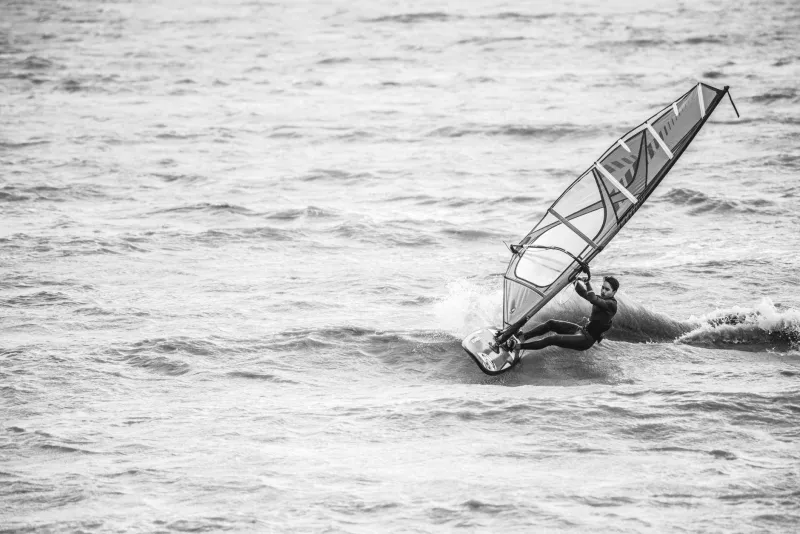
Ask any veteran windsurfer on Maui's North Shore what separates a good session from a transcendent one, and you'll hear a word you might not expect: timing. Not just the tactical kind — knowing when to jibe before a gust stacks up, or when to drop into a wave before it closes out. Something deeper. Something almost musical.
It sounds like a stretch until you start pulling on the thread. Then the whole thing unravels in the most fascinating way.
Neil Pryde's Other Obsession
Most people who know the Neil Pryde story know the iconic parts — the Hong Kong factory, the sails that became synonymous with competitive windsurfing, the brand that helped take the sport from niche curiosity to global phenomenon. What gets talked about less is the man's genuine love of music and how that love quietly shaped the way he thought about design.
People who spent time with Pryde in the early days describe someone who approached sail construction the way a composer approaches an orchestral arrangement. Every panel, every batten, every seam was a note in a larger score. The question was never just does it work — it was does it flow. Does the whole thing breathe together?
That philosophy got baked into the equipment. And when Maui's riders started putting those sails on the water, some of them felt it even if they couldn't name it.
The Rhythm You Can't See But Always Feel
Kihei-based instructor and longtime Maui rider Marcus Tanaka puts it bluntly: "The ocean has a tempo. If you're fighting it, you're exhausted after twenty minutes. If you're riding with it, you can go for hours and feel like you're barely working."
Tanaka spent years teaching beginner and intermediate students before he figured out how to actually communicate this concept. Standard technique language — bend your knees, sheet in, look where you want to go — only gets people so far. What finally clicked was music.
"I started telling students to think of the chop as a drumbeat," he says. "Each little wave is a hit on the snare. The bigger swells are the bass. Your job is to stop trying to overpower the track and just find where you fit in it."
The results were immediate and noticeable. Students who had been stiff, reactive, and exhausted started moving more fluidly. Their transitions smoothed out. Their falls became less dramatic because they were no longer bracing against the water — they were moving with it.
Training to Tempo
Some of Maui's more experimental riders have taken this idea well beyond metaphor. A small but growing group of athletes on the island have incorporated actual music into their dryland and water training, using tempo and rhythm as a literal training tool rather than just an inspirational backdrop.
The concept borrows from what dance athletes and martial artists have known for decades: your body learns movement patterns more efficiently when they're tied to rhythmic cues. Repeating a jibe on land to a consistent beat helps encode the sequence in muscle memory differently — and arguably more durably — than repetition alone.
Kayla Serrano, a competitive wave rider who splits her time between Maui and the Pacific Northwest, started experimenting with tempo-based dryland training after hitting a plateau in her aerial game. "I was landing tricks technically correctly, but they felt mechanical. Stiff," she explains. "A friend who dances suggested I try running through the motion to music. Something with a clear, steady pulse."
Within a few weeks, she noticed her pop felt more natural. The timing of her weight transfer — the moment she shifts from loading the tail to releasing into the air — started happening instinctively rather than consciously. "It's like the music gave my body a reference point that my brain couldn't quite give it."
Reading Conditions with Your Ears
There's another layer to this that doesn't get enough attention: sound as a diagnostic tool on the water itself.
Experienced Maui riders will tell you that before a gust hits, you often hear it. The water surface changes its tone — a kind of low, rushing texture in the air that arrives a split second before the pressure. Sailors who've spent thousands of hours on the water start to respond to that sound automatically, sheeting in or adjusting their stance before the gust is even fully registered visually.
This is the kind of sensory attunement that's almost impossible to teach directly. It comes from time on the water and a willingness to actually listen rather than just watch. But riders who've deliberately practiced auditory awareness — paying attention to what different conditions sound like — tend to develop it faster.
"Ho'okipa has its own soundtrack," says Tanaka. "The way the wind hits the cliff, the way the water sounds different when a set is coming versus when it's flat between sets. Once you know those sounds, you're getting information the person next to you might be missing entirely."
Design That Sings
Coming back to the equipment side of things, Neil Pryde's legacy lives in the way his sails were designed to work with a rider's natural movement rather than demanding constant correction. The best gear in any sport shares this quality — it amplifies intention rather than fighting it.
Modern Neil Pryde sails continue to reflect that philosophy. The profile of a well-tuned sail has a kind of visual rhythm to it — the curve from luff to leech, the tension distribution across panels — that mirrors the arc of a well-executed maneuver. It's not accidental. It's the result of designers who understand that equipment and athlete exist in a feedback loop, and that the best outcomes happen when both sides of that loop are in sync.
That's the musical parallel that keeps coming up when you talk to people who knew Neil Pryde and understood his design thinking. A great sail doesn't just perform — it responds. Like a good instrument in the hands of someone who's put in the hours.
Finding Your Frequency
If you're an intermediate rider looking to break through a performance ceiling, or a beginner who's been struggling to find flow on the water, this rhythm-based perspective might be worth exploring. You don't have to turn your sessions into a music video. Start by just listening more. Notice the sounds your equipment makes at different speeds, in different conditions. Pay attention to the tempo of the chop under your board.
Then, if you want to go deeper, try what Serrano and others have experimented with: run through your transitions and maneuvers on land to music. Pick something with a clear, steady beat — nothing too fast, nothing too slow. Feel where the natural breaks in the rhythm correspond to the transition points in your movement.
You might be surprised how much of windsurfing is already a song. You just have to start listening for it.