Canvas, Wind, and a Wild Idea: The Early Sail Experiments That Built a Windsurfing Empire

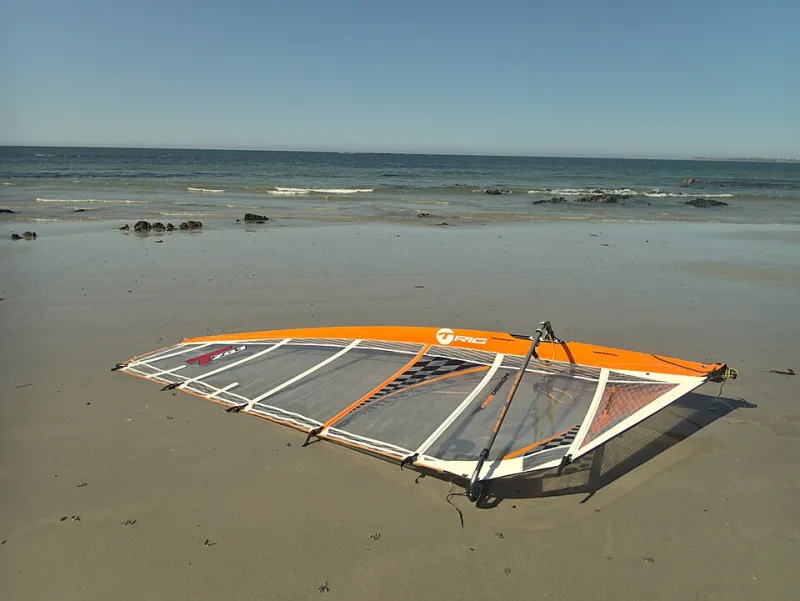
Photo: vintage windsurfing sail design workshop fabric panels close-up, via www.babeyond.com
There's a version of the Neil Pryde story that sounds almost too clean — a visionary designer sees a problem, builds a solution, and changes a sport forever. The real version is messier, more human, and honestly a lot more interesting. It starts with sails that didn't work, waters that punished every mistake, and a stubborn refusal to accept that "good enough" was ever actually good enough.
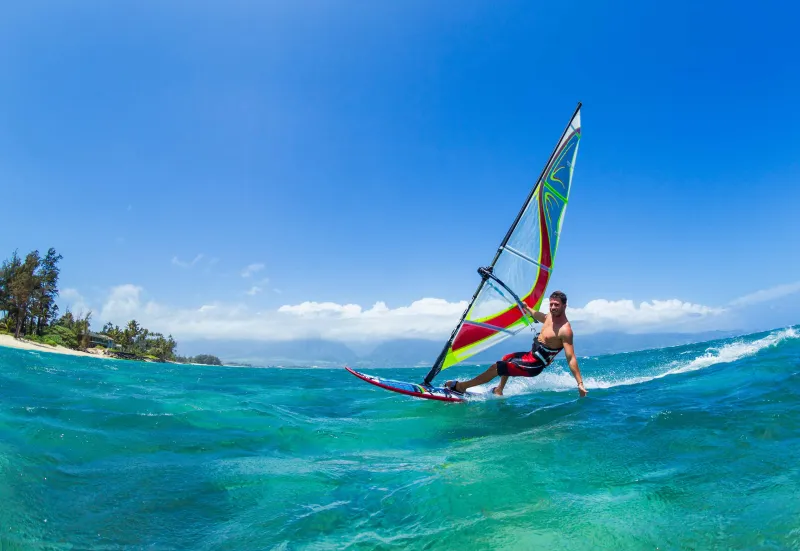
In the early days of windsurfing's rise as a serious sport, the equipment scene was, to put it gently, a work in progress. Riders were essentially slapping sailcloth onto whatever rig they could cobble together, hoping the whole thing wouldn't collapse the moment a serious gust rolled through. On the mainland, that might have been tolerable. On Maui, where the trade winds can shift from playful to punishing in under a minute and the chop at Ho'okipa Beach has humbled more than a few overconfident riders, it was a genuine problem.
The Specific Problem Nobody Was Solving
What made Maui such a brutal testing ground — and ultimately such a perfect one — was the sheer variety of conditions riders had to navigate. You weren't just dealing with consistent wind. You were dealing with Maui wind: thermal shifts off the West Maui Mountains, cross-chop that seemed to come from three directions at once, and the kind of gusty, unpredictable power that made early sail designs feel like they were designed for a completely different ocean.
The core issue with sails of that era came down to shape retention. When you hit a big gust, the sail would deform — belly would blow out, the draft would creep toward the leech, and suddenly you were fighting your own rig instead of riding the wave. For casual paddlers, that was annoying. For riders trying to push performance limits on Maui's North Shore, it was a genuine barrier to progression.
Neil Pryde's early work zeroed in on this problem with an almost obsessive focus. The goal wasn't to build a prettier sail. It was to build a sail that stayed true under pressure — one that held its designed shape whether you were ghosting along in 12 knots or getting absolutely lit up in 30.
Seams, Panels, and the Physics of Shape
The early innovations that came out of Pryde's workshop weren't flashy. They were deeply technical, rooted in an understanding of how fabric behaves under load that most sailmakers at the time simply didn't have — or didn't apply to windsurfing specifically.
One of the foundational breakthroughs involved panel orientation. Traditional sail construction used relatively straightforward seam layouts that made production easier but didn't account for the complex stress patterns a windsurfing sail experiences in dynamic conditions. Pryde's team began experimenting with radial panel layouts — cutting and orienting fabric panels so that the load-bearing threads ran directly toward the high-stress points of the sail rather than across them.
The difference, to anyone who experienced it firsthand, was immediate and unmistakable.
"You'd gybe into a gust and the sail just... stayed there," recalled one longtime Maui rider who got his hands on an early Pryde prototype in the late 1970s. "The previous stuff would twist and the power would go all weird. This thing felt locked in. It felt like the sail actually knew what it was supposed to be doing."
That consistency — the sense that the equipment was working with you rather than requiring constant correction — was the real revolution. It sounds simple in retrospect. At the time, it was genuinely transformative.
Materials That Could Keep Up
Shape retention is only as good as the materials holding that shape, and this is where Pryde's approach really diverged from the mainstream. While a lot of early windsurfing sails were made from whatever dacron or polyester was readily available, the Pryde operation became increasingly focused on sourcing and testing materials specifically for the demands of high-performance sailing.
Mylar laminates — thin films of polyester bonded to woven fabric — started appearing in Pryde designs earlier than in most competitors' work. These materials offered dramatically better stretch resistance than straight woven fabrics, meaning the sail could maintain its engineered shape even after hours of hard use. The tradeoff was durability; early laminates could crack and delaminate if not handled carefully. But on the performance side, the gains were undeniable.
The Maui testing environment was brutal on these materials, which turned out to be exactly what the development process needed. If a laminate held up through a full season at Ho'okipa, it was ready for anywhere.
What Riders Felt Before They Could Explain It
One of the fascinating things about that early transition period is how much riders knew intuitively before the technical explanations caught up. Veterans who rode early Pryde gear consistently describe a sense of "connection" or "directness" that they struggled to articulate but could feel immediately.
What they were experiencing, in technical terms, was the result of better draft stability — the sail's point of maximum depth staying in its designed position rather than migrating aft under load. When draft stays forward and stable, the sail generates cleaner, more predictable power. The rider can actually feel what the wind is doing and respond to it, rather than constantly chasing a shape that's morphing beneath them.
For competitive riders, this was a game-changer. For recreational sailors on Maui's more forgiving breaks, it meant the difference between a frustrating afternoon and a genuinely joyful one.
A Foundation That Still Holds
Decades later, the core principles that came out of those early experiments are still visible in modern high-performance windsurfing sails. Radial construction, load-path-aligned panels, laminate film faces — these aren't just features on a spec sheet. They're the direct descendants of solutions worked out on Maui's water when the sport was still figuring out what it even wanted to be.
The garage-to-global arc of Neil Pryde's early work is a genuinely American story in some ways — the tinkerer who sees a gap nobody else is filling and just starts building. But it's also unmistakably a Maui story. The island's wind didn't care about your prototype. It was going to test whatever you brought out there, and it was going to tell you the truth about it.
Turns out, that kind of honest feedback is exactly what a revolution needs.