Shaping the Future: How Experimental Board Design in Maui Rewrote the Rules of Windsurfing

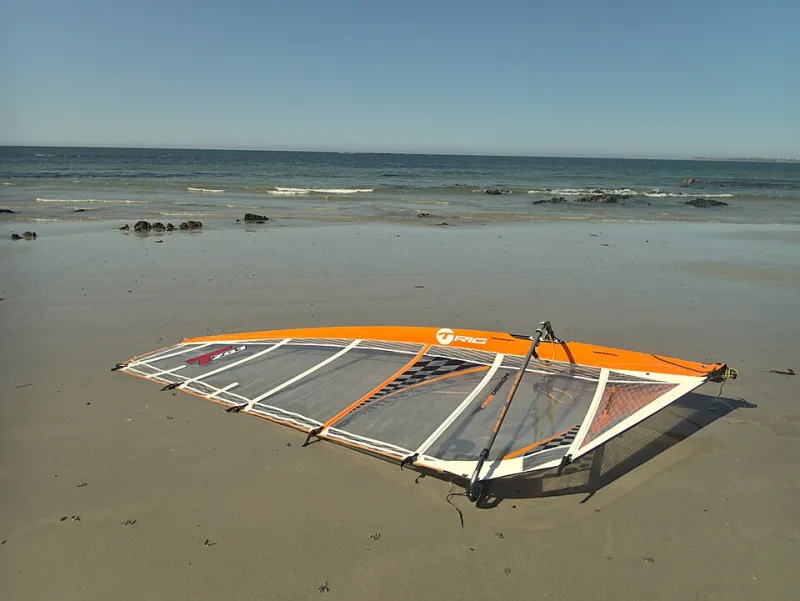
Photo: VYGOcommons, Public domain, via Wikimedia Commons
There's a certain kind of magic that happens when you put obsessive tinkerers near world-class wind and water. Maui has always been that kind of place — a living laboratory where conditions are punishing enough to expose every flaw and forgiving enough to keep you coming back. For Neil Pryde and the circle of shapers and riders he inspired, this island wasn't just a backdrop. It was the testing ground where modern windsurfing boards were essentially invented from scratch.
The early days weren't glamorous. We're talking foam dust on concrete floors, hand-shaped blanks propped against rusted shelving, and arguments that stretched long past sunset about rocker lines and fin placement. But out of that chaos came something remarkable: a design philosophy grounded in real-world feedback rather than theory alone.
Starting From Zero — On Purpose
What set the Neil Pryde approach apart from the beginning was a willingness to question everything. In an era when most manufacturers were iterating on existing surfboard templates and slapping a mast track somewhere in the middle, Pryde's collaborators were asking more fundamental questions. What does a board actually need to do at 30 knots? How does the outline interact with chop when you're fully powered up? What happens to the flex pattern when you push into a jibe at speed?
These weren't hypothetical questions. They were answered by riding the boards at Ho'okipa and Kanaha, then dragging them back to the shaping bay to make changes — sometimes the same afternoon. That rapid feedback loop, which modern product developers now call iterative prototyping, was just survival instinct back then. If your board didn't work, you knew it immediately.
Early experimental shortboards from this era pioneered what riders came to call "functional volume" — distributing foam in ways that kept the board lively underfoot without the sluggishness of earlier longboard-derived designs. The tail rocker profiles developed through this process, particularly the subtle double-concave channels that became a Pryde-influenced signature, are still found in high-performance freeride and wave boards manufactured today.
The Models That Changed Everything
A few specific designs deserve recognition as genuine turning points.
The move toward dedicated wave boards — shorter, narrower, with pulled-in pintail templates — was accelerated by Maui's unique wave conditions. Ho'okipa breaks hard and fast, and it exposed the limits of multipurpose equipment almost immediately. Boards shaped to handle that break needed to pivot quickly, absorb impact, and release from the lip without sticking. The solutions developed for that specific challenge — including refined outline curves and strategically placed concaves — migrated into production boards within a few seasons and became universal.
On the other end of the spectrum, the development of wider, planing freeride shapes in the late 1980s and into the 1990s drew heavily on principles tested on Maui's flatter bays. Getting average riders onto the plane faster, with more stability and less technical demand, required rethinking width distribution entirely. Boards that were considered "too wide" by the competitive crowd turned out to be exactly what the growing recreational market needed — and that market eventually became the backbone of the entire industry.
What Contemporary Shapers Say
Talk to board builders working today and the Pryde-era influence comes up almost immediately. Shapers who came up in the 1990s describe studying production boards from that period the way music students study recordings — reverse-engineering the geometry to understand the decision-making behind each curve.
"The thing that still impresses me is how much they got right without the tools we have now," says one California-based shaper who has been building custom windsurfing and SUP boards for over two decades. "You look at a well-executed board from that Maui experimental period and the rocker, the outline, the fin box placement — it all makes sense. They were solving problems empirically, and the solutions hold up."
The influence isn't just nostalgic. Modern CNC-shaped boards still reference template libraries that trace back to hand-shaped originals from this era. Fin systems developed to accommodate the performance demands of Maui's conditions evolved into the standardized box systems now used across the industry. Even the materials conversation — the shift toward lighter, stiffer construction using carbon and advanced composites — was driven in part by the performance benchmarks set on this island.
Why Maui Made the Difference
It's worth pausing to appreciate why Maui specifically mattered so much to this story. The island offers a remarkable range of conditions within a short distance — mast-high surf at Ho'okipa, consistent side-shore trade winds at Kanaha, and everything in between depending on the season. A board that could handle that variety, or one that excelled in a specific slice of it, had been genuinely tested.
There's also the community factor. Maui in the formative years of windsurfing was small enough that shapers, riders, and equipment developers were constantly in conversation with each other. Ideas moved fast. A modification tested on a Tuesday could be discussed at the beach on Wednesday and incorporated into a new prototype by the following week. That density of talent and feedback in a single place accelerated innovation in ways that a more dispersed industry couldn't replicate.
The Living Legacy
Walk into any serious windsurfing shop in the US today — whether you're in Hood River, Oregon, the Outer Banks in North Carolina, or right here on Maui — and you're looking at equipment that carries the fingerprints of this experimental era. The board under your feet on your next session reflects decisions made in a Maui workshop decades ago, refined by riders who cared more about getting it right than getting it done quickly.
That's the real tribute to what Neil Pryde and his generation built: not just specific products, but a standard of rigor and a culture of honest testing that the industry absorbed and carried forward. The garage experiments are long over. The results are everywhere.