Built to Ride: The Design Philosophy That Changed Windsurfing Forever
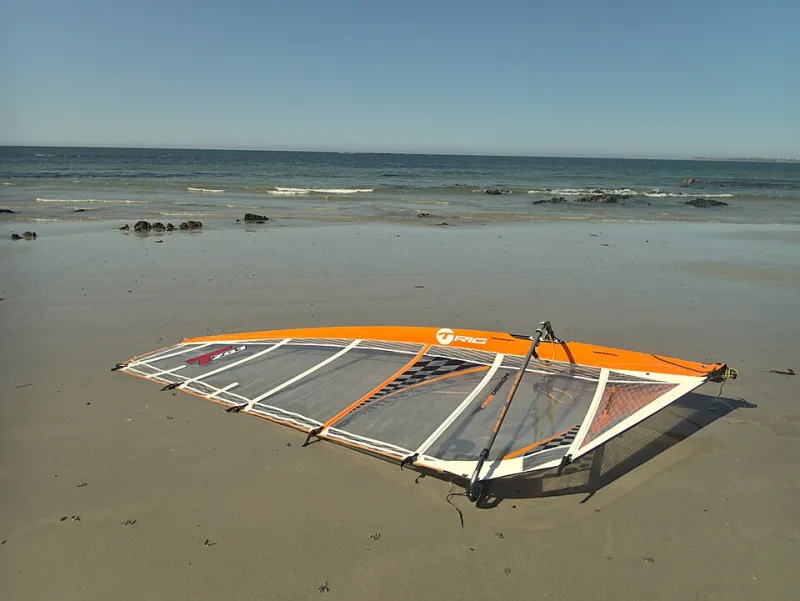
Photo: PtiBzh, CC0, via Wikimedia Commons
There's a certain kind of obsession that doesn't stay contained to business hours. It spills into weekends, fills notebooks, and eventually takes over whatever open floor space is available. For Neil Pryde, that obsession was sail design — and the garage-level experimentation it demanded ended up reshaping an entire sport.
Windsurfing in its early commercial days was a rough-around-the-edges pursuit. Gear was heavy, unforgiving, and often designed with competitive elites in mind rather than the weekend warrior trying to catch their first real gust off Kanaha Beach. Pryde saw that gap and decided to close it — not by dumbing things down, but by engineering smarter.
From Stitching Tables to the Shore
Pryde's background in sail-making wasn't accidental. Long before windsurfing had its cultural moment, he was deep in the craft of building sails for competitive racing yachts — work that demanded precision, an understanding of material behavior under load, and a relentless focus on aerodynamic efficiency. Those fundamentals didn't get left behind when he pivoted toward the emerging windsurfing market. They got applied with fresh eyes.
What separated his early designs from competitors wasn't just technical execution — it was intent. Pryde approached each prototype as a problem to solve, not a product to sell. According to equipment historians and longtime industry observers, his workshop process involved constant iteration: testing a sail on the water, noting how it responded to different wind angles and rider weights, then going back to the drawing board without ego.
"He wasn't precious about throwing out a design that wasn't working," notes one longtime equipment specialist who studied Pryde's development cycles. "That willingness to start over was actually a competitive advantage. Most manufacturers were trying to protect their tooling investments. He was trying to protect the rider's experience."
The Monofilm Moment and Material Innovation
One of the most consequential shifts in windsurfing sail construction came with the broader adoption of monofilm panels — transparent, lightweight polyester film that dramatically reduced sail weight while improving visual feedback for the rider. Pryde's team was among the pioneers in figuring out how to integrate these materials without sacrificing durability, which was the real engineering challenge nobody talks about enough.
Lightweight materials fail in predictable ways when they're not supported correctly. The seam construction, the batten pocket placement, the reinforcement at high-stress points — all of it had to be rethought when you moved away from traditional woven Dacron. Pryde's sail-making heritage gave his team a structural intuition that pure windsurfing startups simply didn't have.
The result was gear that felt alive in your hands. Riders who made the switch often described it as the difference between driving a truck and driving a sports car — everything was more responsive, more communicative, more fun.
Accessibility Without Compromise
Here's the part of Pryde's philosophy that doesn't always make it into the highlight reels: he genuinely believed that high performance and broad accessibility weren't mutually exclusive. That sounds obvious now, but in the early days of the sport, there was a prevailing attitude that serious gear was for serious athletes and recreational gear was, well, recreational — meaning slower, heavier, and less refined.
Pryde pushed back on that binary. His design team worked to create product lines where the technology developed for competitive sailing trickled down into gear that intermediate riders could actually use and learn from. Rigging systems became more intuitive. Sail profiles were engineered to be more forgiving in gusty, unpredictable conditions — which, if you've spent time on the water in the US, describes pretty much every afternoon session from the Pacific Coast to the Great Lakes.
This democratization of performance gear had a ripple effect on participation. When beginners could access equipment that actually helped them improve rather than fighting them every step of the way, the sport grew. Shops reported better retention rates. Instructors had an easier time getting students to stick with it past the initial learning curve.
Design Principles That Outlasted the Trends
Windsurfing went through some turbulent decades. The sport exploded in the '80s, contracted sharply in the '90s as kiteboarding and SUP emerged, and has since settled into a passionate, dedicated community that takes its gear seriously. Through all of that, the design principles Pryde established have proven remarkably durable.
Modern sail designers still grapple with the same core tensions he identified: weight versus strength, stability versus responsiveness, ease of use versus peak performance. The materials have evolved — we're seeing more sophisticated laminate constructions, carbon fiber battens, and digitally-modeled panel shapes — but the underlying philosophy of testing relentlessly and prioritizing the rider's actual experience on the water? That's straight out of the Pryde playbook.
Equipment reviewers who cover the current market frequently point to products that trace their conceptual DNA back to innovations Pryde's team introduced. The cambered inducer systems that help modern race sails hold their shape in high winds, the reinforced clew designs that handle the brutal loads of wave riding, the thoughtfully placed window panels that give riders better visibility — these aren't accidents. They're the accumulated wisdom of a design culture he helped establish.
What It Means for Today's Rider
If you're standing in a shop right now trying to figure out which sail to buy for your sessions off Maui's north shore, or planning a trip and wondering what gear to rent, the legacy of this design philosophy is working in your favor. The baseline quality of windsurfing equipment available today — even at mid-range price points — would have been considered elite-level performance gear not that many years ago.
That's not a coincidence. It's the compounded result of designers who took the craft seriously, who refused to accept mediocrity as the price of accessibility, and who kept going back to the water to test whether their ideas actually held up when the wind got real.
Neil Pryde's contribution to windsurfing isn't just a chapter in the sport's history — it's baked into the equipment sitting in your quiver right now. Every clean gybe, every powered-up run, every moment where the gear just disappears and it's only you and the wind: there's a little bit of that garage workshop in there.