The Sound of Speed: How Neil Pryde Boards Spoke a Language Only True Riders Could Hear
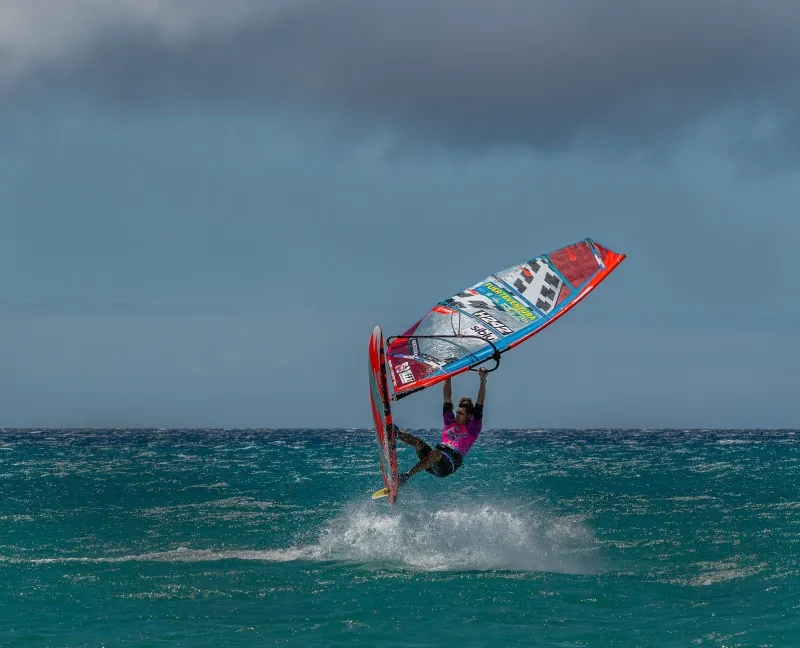
There's a moment on the water—somewhere between a gust hitting the sail and the board fully planing—when the deck beneath your feet starts to talk. It vibrates. It hums. It pushes back in ways that are hard to put into words but impossible to ignore once you've felt them. For a generation of windsurfers who grew up riding Neil Pryde equipment, that conversation was unmistakable. You didn't need to look at a logo. You just knew.
Calling it "feel" undersells it. What longtime riders describe is closer to a full acoustic signature—a combination of resonance, flex response, and vibration frequency that was as distinctive as a fingerprint. And unlike top-sheet graphics or fin box placement, nobody ever wrote it down in a spec sheet.
More Than Marketing: The Physics Behind the Feel
To understand what made Pryde boards sound and feel different, you have to start with materials. During the era when Neil Pryde's influence over board construction was at its peak, the industry was still figuring out how carbon fiber, fiberglass, and foam cores could be combined in ways that went beyond simple weight reduction.
Pryde's team wasn't just chasing lighter. They were chasing responsive. The layup schedules—the precise arrangement of fabric plies before a board goes into the mold—were dialed in with an almost obsessive attention to how energy would travel through the structure. Stiffer in some zones, subtly compliant in others. That anisotropic quality meant the board didn't just absorb chop; it filtered it, returning useful feedback to the rider's feet while dampening the junk.
The result was a board that vibrated at frequencies experienced riders learned to read. High-frequency buzz through the heel meant you were pushing the rocker too hard into a turn. A low, steady thrum under the front foot was the signal that you'd found the sweet spot on a reach. It sounds almost mystical described this way, but the physics are real. Different layup configurations produce different natural frequencies, and Pryde's construction happened to land in a range that riders found both informative and intuitive.
Eyes Closed, Board Known
Spend enough time around Maui's windsurfing community and you'll hear versions of the same story. A rider gets handed an unfamiliar board—maybe at a demo day, maybe borrowed from a friend—steps on it, and within thirty seconds says, "This is a Pryde, isn't it?"
Mike Carlin, who has been riding out of Ho'okipa for close to twenty-five years, describes it as a low-frequency conversation. "Other boards are louder but say less," he says. "A Pryde board would hum at you. Not aggressively. More like a tuning fork that had been set to exactly the right pitch for the conditions."
Sandra Reeves, a Hawaii transplant from San Diego who started competing in the mid-nineties, puts it differently. "I used to close my eyes on flat water runs just to listen. The board had this specific sound when it was fully powered up—kind of a sustained, clean tone under the front foot. Nothing I've ridden since has hit that exact note."
These aren't isolated impressions. Talk to enough veteran riders and a consistent vocabulary emerges: tone, resonance, conversation, frequency. Nobody was taught these words in a clinic. They developed organically because the experience demanded them.
The Fingerprints You Can't Fake
Beyond acoustics, there were subtler design signatures embedded in Pryde boards that experienced eyes and hands could identify. The concave geometry under the front foot was slightly more pronounced than competitors of the same era—a choice that affected both water release and the way vibration traveled forward through the hull. Rail profiles were finished with a consistency that bordered on fanatical; the transition from the flat deck to the tucked-under edge was smooth in a way that you could feel with your thumb even before you stepped on.
Fin box placement, too, carried a signature. Pryde's team had specific opinions about how the fin's lateral position relative to the board's centerline affected feel at speed, and those opinions were baked into molds that didn't change casually. Riders who switched between brands noticed immediately—not because the numbers were dramatically different, but because the whole system had been tuned differently.
Why Modern Boards Can't Quite Get There
Here's where the story gets a little melancholy for the gear obsessives. Contemporary boards are, by almost every measurable standard, better than what Pryde was building at the height of his influence. Lighter. Stiffer where it counts. More durable. The manufacturing precision available today would have seemed like science fiction in the eighties and nineties.
And yet.
Several riders who've spent serious time on both vintage Pryde equipment and current production boards from top-tier brands describe something missing—not a deficiency exactly, but an absence. Modern boards are often described as quiet. Efficient, yes. Fast, absolutely. But quiet in a way that removes some of the dialogue that older riders relied on.
Part of this is intentional. Modern construction techniques are explicitly designed to minimize vibration transmission to the rider, on the theory that vibration equals energy loss and energy loss equals slower. That's not wrong. But it does mean that the acoustic feedback loop Pryde boards provided has been engineered away in the pursuit of objective performance metrics.
Some manufacturers have tried to reintroduce tunable flex zones and variable-density core materials to bring back some of that feel. The results are promising but not identical. Replicating a specific resonant frequency requires knowing exactly what you're targeting, and the original Pryde signature wasn't the product of a deliberate acoustic design process—it was an emergent property of a hundred small decisions made by people who were chasing something they couldn't fully articulate.
The Intangible as Legacy
What the Neil Pryde board story ultimately tells us is that the most meaningful qualities in performance equipment are often the hardest to quantify. Specs can be copied. Geometries can be measured and reproduced. But the feel of a board that was built by people obsessed with a specific kind of rider experience—that's harder to reverse-engineer.
For the riders who still have vintage Pryde boards in their garages, those boards aren't just collectibles. They're reference points. A way of remembering what it felt like when equipment talked back. When the ocean, the wind, and a well-built board were having a three-way conversation that you got to be part of.
Maui's water has a way of making you pay attention to exactly that kind of thing. And Neil Pryde's boards, at their best, were built for exactly that kind of listening.