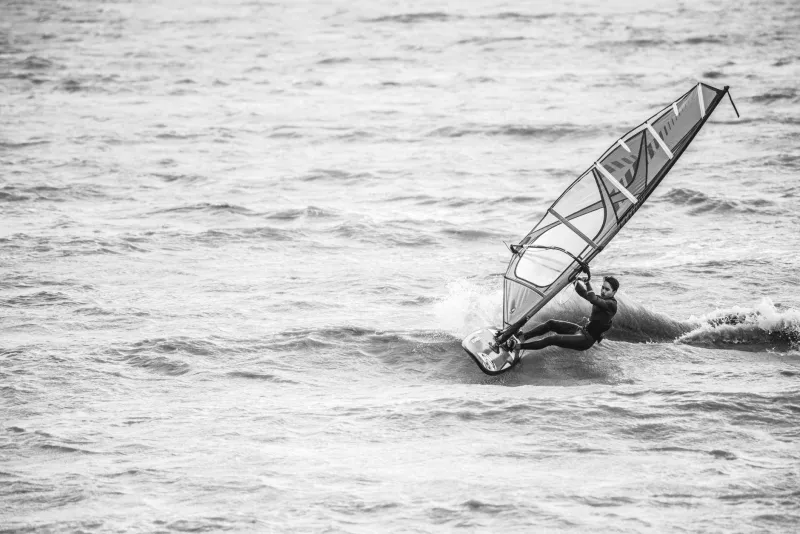
Bet the Board: The Radical Designs That Almost Sank Neil Pryde—And Then Saved the Whole Industry
Photo: vintage experimental windsurfing board prototype workshop design, via i.pinimg.com
There's a version of windsurfing history where Neil Pryde's most daring experiments quietly died in a warehouse somewhere, unsold and unloved, taking the company down with them. That version didn't happen. But it almost did—more than once.
The real story is messier, riskier, and a whole lot more interesting than the polished brand mythology might suggest. It's a story about a designer and a company willing to look completely wrong in public, absorb real financial pain, and keep pushing anyway. For anyone who rides on Maui's water today, understanding that story changes how you think about the gear under your feet.
The Board Nobody Asked For
In the early days of performance windsurfing, the market had a pretty clear idea of what a board should look like. Long, stable, forgiving—something a weekend warrior in California or Florida could step onto without immediately swimming. Volume was safety. Width was confidence. The formula worked, and the industry was comfortable with it.
Then Neil Pryde's design team started asking uncomfortable questions. What if you stripped the board down to almost nothing? What if you built something that demanded skill instead of compensating for the lack of it? What if the board forced the rider to get better rather than making it easier to stay mediocre?
The answers produced shapes that looked almost alien next to what was on the market. Narrow tails, dramatically reduced volume, rocker lines that made experienced riders raise their eyebrows. When early prototypes hit the water on Maui, reactions ranged from polite skepticism to outright mockery. Retailers who saw the designs at trade shows passed. Some distributors didn't even bother responding.
From a business standpoint, the timing couldn't have been worse. The production costs on experimental shapes were steep, the tooling investments were significant, and the consumer base that might eventually embrace the designs was years away from existing in meaningful numbers.
The Financial Reckoning
It's worth sitting with the actual stakes here, because the windsurfing industry in the late 1970s and through the 1980s was not a forgiving environment for bold bets. Margins were thin, distribution networks were fragile, and brand loyalty hadn't yet calcified the way it would later. A company that burned capital on product lines consumers wouldn't buy could disappear quickly.
Neil Pryde's experimental board program came close to that edge. Production runs on radical shapes moved slowly. Inventory sat. The cash flow implications were real and serious. There were internal conversations—the kind that happen in every company that's ever risked too much on a vision—about whether to pull back, play it safe, and give the market what it was already asking for.
The fact that those conversations didn't end in retreat is the hinge point of the whole story.
When the Skeptics Became the Converts
What changed wasn't the designs. It was the riders.
As a generation of windsurfers started pushing harder at what was possible on the water—particularly in the kind of demanding conditions that Maui's Ho'okipa Beach serves up on a regular basis—the limitations of conventional boards became impossible to ignore. Stable and forgiving was fine until you wanted to actually throw the thing around in serious chop. Volume was reassuring until it became an anchor.
The experimental shapes that had been gathering dust suddenly looked like they'd been built for exactly this moment. Riders who'd dismissed them started quietly borrowing demo units. Then they started buying. Then they started winning on them.
Old-school shop owners who'd declined to carry the line started calling. Pros who'd been skeptical showed up at events riding gear they'd once laughed at. The conversion wasn't instant or universal, but it was real—and it was driven entirely by performance on the water rather than any marketing push.
That's a particular kind of vindication. Not the kind where you get to say "I told you so" in a press release, but the kind where the product simply proves itself in conditions that don't care about anyone's opinion.
What the Design Iterations Actually Taught
Looking back at the specific shapes that caused the most controversy, a few consistent principles emerge from the chaos.
First, the radical designs were almost always optimized for a specific type of rider in a specific type of condition. They weren't trying to be everything to everyone. That narrowness of purpose was exactly what made them feel wrong to a broad market and exactly right to the riders who eventually embraced them.
Second, the most controversial features—the ones that drew the most skepticism—tended to be the ones that mattered most. Reduced volume forced better technique. Narrower tails demanded cleaner footwork. The board wasn't hiding anyone's mistakes, which meant that riders who put in the work got dramatically better faster.
Third, and maybe most importantly, the willingness to be wrong in public created a feedback loop that conventional product development couldn't replicate. When you're putting genuinely strange shapes on the water at a place like Ho'okipa, in front of some of the most technically demanding riders in the world, you learn things fast. The failure modes are immediate and obvious. The refinements that come out of that process are battle-tested in a way that focus group data never could be.
Lessons That Live in the Water
For modern windsurfers, the legacy of those controversial prototypes isn't just historical trivia. It's embedded in the geometry of contemporary boards in ways that are easy to take for granted.
The performance expectations that feel standard today—the responsiveness, the precision, the way a well-designed board rewards technical riding—trace back directly to those early experiments that the market initially rejected. Every time you feel a board respond cleanly to a weight shift in serious chop, you're experiencing the downstream effect of a design philosophy that nearly broke the company before it transformed the industry.
There's also a broader lesson here that applies beyond gear selection. The willingness to absorb short-term rejection in pursuit of a longer-term vision is genuinely rare in any industry, and it's especially rare in action sports, where cool is currency and being wrong publicly is expensive. Neil Pryde's design history is a case study in what happens when a company decides that being right eventually matters more than being accepted immediately.
The Calculated Risk as a Way of Riding
Maui's water has a way of teaching this lesson directly. Anyone who's spent real time at Ho'okipa or Kanaha knows that the conditions reward commitment. Half-measures get punished. The rider who hesitates at the lip of a wave, who pulls back from a move because they're not sure it'll work, usually ends up in a worse position than the one who committed fully to something that didn't quite come off.
Neil Pryde's most controversial boards were built by people who understood that dynamic—who'd internalized the idea that calculated risk, absorbed with full commitment, produces better outcomes than cautious half-measures, even when it hurts on the way there.
The boards that almost sank the company are the reason the company is worth talking about. That's not a comfortable story, but it's the true one.