Reading the Invisible: The Mental Disciplines That Turn Maui's Best Windsurfers Into Water Whisperers

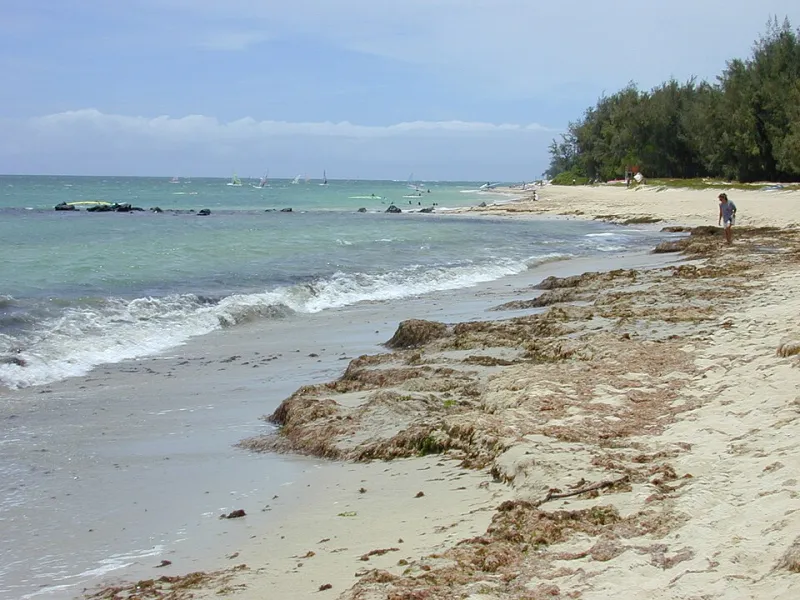
Photo: Coconino National Forest, Public domain, via Wikimedia Commons
Something Happens When You Watch Long Enough
Spend a morning at Ho'okipa Beach Park on Maui's North Shore and you'll notice something that no equipment review can explain. Out on the water, among a field of skilled riders, there are a handful who move differently. They don't seem to be reacting to the wind — they seem to be anticipating it. A gust builds offshore and they're already adjusting their stance. A wave section closes out and they've already committed to a line that takes them cleanly through.
Ask those riders what they're doing and most of them will pause, look slightly puzzled, and say something like: "I don't know, I just felt it."
That answer is more honest than it sounds.
The Science Behind the Feeling
Sports psychologists have a term for what Maui's best windsurfers have developed: perceptual-cognitive expertise. It's the ability to extract meaningful information from an environment faster and more accurately than a less experienced observer — not because of superior eyesight or faster reflexes, but because of a mental framework built from thousands of hours of immersive attention.
In simpler terms: when you've watched the same stretch of water long enough, your brain starts building models. It learns what a certain chop pattern means about wind direction. It recognizes the subtle darkening of the water's surface that signals a gust moving in from the northeast. It connects the behavior of birds, the movement of distant whitecaps, the particular sound of wind through the ironwood trees lining the beach — and synthesizes all of it, in real time, into something that feels like intuition but is actually pattern recognition operating at speed.
Dr. Jennifer Tao, a sports performance consultant who has worked with ocean athletes on the mainland, describes it this way: "What we call intuition in elite athletes is really compressed experience. The feeling of 'just knowing' is your brain running a very fast calculation based on a very large dataset. The dataset is everything you've ever seen and felt on the water."
For Maui's windsurfing community, that dataset is extraordinary. The island's conditions — the interaction of trade winds with volcanic topography, the complex wave patterns generated by North Pacific swells, the thermal shifts that can change everything in a matter of minutes — are genuinely unlike anywhere else on earth. Riders who've spent years here aren't just experienced. They're experienced in a classroom that has no equivalent.
The Practice Nobody Sees
Here's what most people don't realize about Maui's legendary riders: the mental training doesn't happen on the water. Or rather, it doesn't only happen on the water.
Some of the most respected figures in the local windsurfing community have daily practices that look more like meditation than athletic training. Early mornings at the beach, before the wind comes up, just watching. Not checking gear, not warming up — watching. The way the light hits the surface. The direction and rhythm of the shore break. The behavior of the trades as they funnel through gaps in the West Maui Mountains.
Kai Nalua, a Maui-based instructor who has been teaching windsurfing for over twenty years, describes his morning ritual as "reading the newspaper." "Every morning the ocean tells you what's going to happen that day," he says. "But you have to learn the language first. And the language takes years."
That language includes things most riders never consciously study: the color gradients in the water that indicate depth changes and current shifts, the particular behavior of whitecaps at different wind speeds, the way swell period affects how waves interact with the reef at Ho'okipa. None of it is taught in a formal curriculum. It's absorbed through presence — through showing up, paying attention, and resisting the urge to always be doing something.
Fear, Focus, and the Art of Not Overthinking
There's another dimension to the mental game that doesn't get discussed enough, partly because it's uncomfortable: fear management.
Maui's water is beautiful and it's also genuinely dangerous. The reef at Ho'okipa has ended sessions and, in rare cases, careers. Maalaea Harbor's speed runs carry real consequences when things go wrong. The channels between Maui and Moloka'i generate conditions that demand complete commitment and zero hesitation.
Riding at this level requires a particular kind of psychological relationship with fear — not the elimination of it, which is both impossible and actually counterproductive, but the ability to feel it without letting it fragment your attention. The riders who last on Maui's most challenging spots have learned to use fear as information rather than noise.
"Fear tells you something real," says one longtime Ho'okipa regular who asked to remain unnamed. "The trick is learning to hear what it's actually saying instead of just reacting to the volume."
This is where the meditation-adjacent practices that many Maui riders maintain start to make practical sense. The ability to stay present, to process incoming information without being overwhelmed by it, to make decisions under pressure without the mental chatter that causes hesitation — these aren't soft skills. On serious water, they're survival skills.
What the Mainland Rider Can Take Home
Most of us aren't going to spend years on Maui's North Shore building the kind of perceptual database that separates the legends from everyone else. But the principles behind it are transferable, even to the weekend rider catching sessions at their local lake or coastal break.
The core practice is simpler than it sounds: slow down your relationship with the water before you try to go fast on it. Spend time at the launch before you rig. Watch the conditions without an agenda. Ask yourself what the surface is telling you, even if you can't fully interpret the answer yet. Every session you approach this way adds a small entry to that mental dataset — and over time, those entries compound.
Neil Pryde's connection to Maui was never just about equipment. It was about a philosophy of engagement with the water — one that respected the ocean's complexity and rewarded the riders who took the time to understand it rather than just conquer it. The mental game those legendary riders play every morning at Ho'okipa is the purest expression of that philosophy.
The water doesn't give up its secrets to the fastest rider. It gives them up to the most attentive one.